
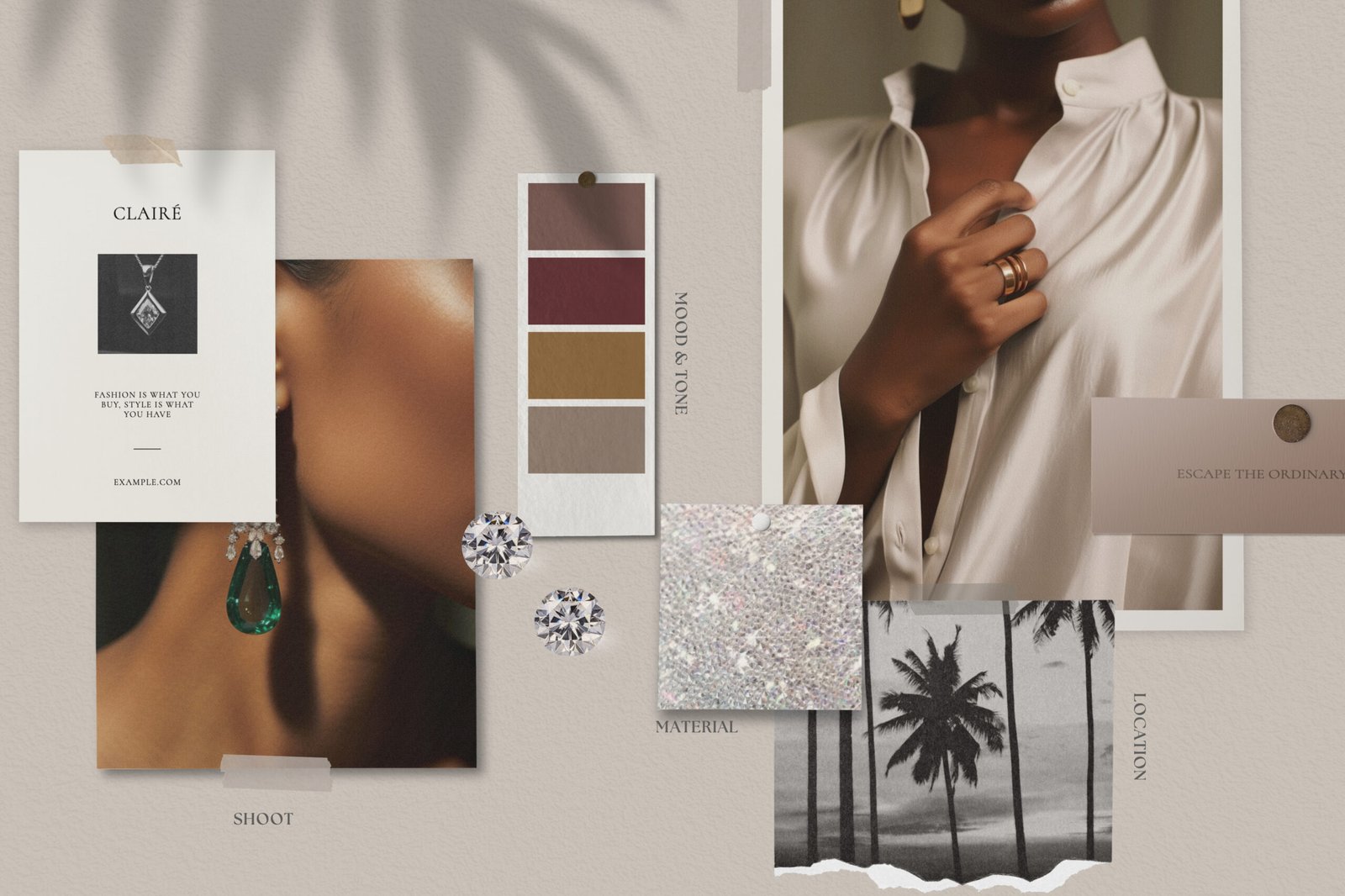
You know exactly how it should feel. Like walking into a sunlit kitchen. Like a long exhale. Like the first page of a book you already know you’re going to love. But try to describe your vision out loud, and it slips away.
What you can’t do is say what it should look like. And every time someone asks, “So, what are you picturing?” your brain offers a blank wall and a very polite shrug.
I want you to hear this: that isn’t a gap in your vision. It’s the most normal starting point there is. And honestly? It’s my favorite place to begin.
Short answer: Feeling your vision before you can see it is a normal and useful stage of creating anything. The feeling is the vision; it just hasn’t been translated yet. You make it visible by describing the feeling in sensory words, naming what it isn’t, collecting real-world references that carry it, and reacting to rough drafts until one makes you say, “Yes. That.”
Is it normal to know how something should feel but not how it should look?
Completely normal. For a lot of people, the feeling arrives first and the visual and practical details come later, through translation and a few rounds of trying things.
There’s a myth that “real visionaries” see the finished thing in full HD before they start. Some people do work that way. Plenty don’t, and being unable to describe your vision on day one doesn’t make it any less real. A feeling is a very precise kind of information. It just isn’t written in the language of layouts, color codes and feature lists.
I started making things on screens more than 25 years ago, in Microsoft Paint, then Paint Shop Pro, then hand-coded HTML on GeoCities and early WordPress. Every one of those tools has come and gone. The thing I was actually doing with all of them never changed: taking something that existed as a feeling and giving it a shape people could click on.
Why can’t I describe my vision?
Because you’re trying to describe a feeling in the vocabulary of features (“a logo,” “a homepage,” “an app”), and features are the wrong vocabulary for it. Switch to sensory, comparative language and the words usually come.
A few other things get in the way, too:
- The question skips a step. “What should it look like?” jumps straight to the end. Nobody asks, “What should it feel like?” first, so you freeze.
- You’re scared of being misunderstood. If you say it out loud and someone gets it wrong, it can feel like the vision got smaller. So you say nothing.
- You’re scared the real thing won’t match the feeling. That’s a very human fear, and the answer to it is iteration, not perfect description.
Saying “I don’t know what it looks like yet” isn’t failing. It’s honest. And honest is the only place good work can start.

The Translation Ladder
This is how I bring something from felt to real. Each rung makes the feeling a little more concrete without losing it along the way.
- Feeling. Describe it with your senses. What temperature is it? What pace? What kind of light? What texture? What sound? “Warm, slow, golden-hour, linen, a low hum.”
- Contrast. Name what it is not. “Not slick. Not corporate. Not cutesy.” Your “not” list is often more precise than your “is” list, and that’s perfectly fine. Sculptors work by removing, too.
- Words. Distill it into three to five words and one sentence: “It should feel like ___ for people who ___.”
- References. Gather real things that carry the feeling: rooms, places, objects, fabrics, music, other brands from completely different industries. Not just websites. A website made only from other websites ends up looking like everybody’s.
- Rough form. Make something fast and a little ugly: a sketch, a mood board, a rough page, a clickable prototype. Feelings respond to things, not descriptions.
- Refine. React out loud. “Warmer.” “Slower.” “Less shiny.” “That button feels pushy.” Each round brings it closer to the feeling.
Notice that rungs one through four don’t require any visual skills to describe your vision. They only require honesty. Rungs five and six are where a translator becomes really useful.
What does this look like in real life?
Here’s a hypothetical example. Let’s say you’re a yoga teacher with an idea for a small app: a place your students can check in with themselves between classes. You can feel it. You just can’t picture it.
- Feeling: “Like Sunday morning with the windows open.”
- Contrast: “Not a fitness tracker. No streaks, no badges, nothing that makes anyone feel behind.”
- Words: spacious, gentle, unhurried. “It should feel like a deep breath for people who are tired of being optimized.”
- References: an old linen tablecloth, a slow piano album, the hush of a library, a handwritten note left on a kitchen counter.
- Rough form: one screen with one question (“How’s your body today?”) and three soft buttons. No dashboard. No charts.
- Refine: “Too clinical. Warmer color. Fewer words. Make the question feel like a friend asking.”
Look at what happened. Nobody had to see the app first. The feeling made every decision. No streaks, because “nothing that makes anyone feel behind.” One question per screen, because “unhurried.” The vision was there the whole time. It just needed translating.
How do I describe my vision to a designer or developer?
Give them the feeling, your “not” list and your references, not just a list of features. Then ask for something rough early, so you can react to something real instead of trying to describe the perfect version in advance.
A simple brief you can copy:
- “When people use this, I want them to feel…”
- “It should never feel…”
- “Here are five things (not all websites) that carry the feeling…”
- “The one thing it absolutely has to do is…”
- “Please show me something rough before you make it pretty.”
The right person for this kind of work asks more questions than they answer at first. If someone hands you their taste instead of translating yours, that’s a fit problem, not a you problem. Your vision deserves someone who is curious about it.
Why start with the feeling instead of the picture?
Because the feeling is the part that’s truly yours. Everything else can be designed, coded, rewritten and rebuilt. The feeling is the source.
This is also why I’ll never tell you I know what your vision looks like before you do. I don’t. You’re the one who can feel it. My gift is translation: helping you bring it from non-physical to something real online, whether that’s a brand, a website, an app or a system, without losing the thing that made it yours along the way. You hold the vision. I bring the translation tools, the questions and 20+ years of practice.
That’s where the spiritual and the practical hold hands in my work: the feeling leads, and the strategy makes sure it can actually be built.
Try this today: describe your vision in 15 minutes
Do a feeling inventory:
- Answer five questions about your vision: What temperature is it? What pace? What light? What texture? What sound?
- Write a “not” list of at least five things it should never feel like.
- Find three references that aren’t websites, from your home, your camera roll or a walk around the block.
- Finish the sentence: “It should feel like ___ for people who ___.”
Read it all back. You may be surprised by how well you can already describe your vision. You had the vision all along. Now you have the first words for it.
Want a translator in the room?
If you’d like help climbing the ladder, coaching with me is a thinking partner for exactly this kind of not-quite-describable thing. One session works when you have one clear idea to untangle, and ongoing support works while it evolves. You don’t have to arrive prepared. A feeling and a few “nots” is a wonderful start.
And if the thing you can feel is an app, a digital product, an AI workflow or a system, my AI & apps work is built for turning the thing in your head into something real. We can build it together, with me coaching you through every stage from idea to launch, or I can build it for you.
Quick answers
Why can I feel my vision but not see it?
You can feel your vision but not see it because feelings usually arrive before visual details. A feeling is real, precise information, just not in the language of layouts or features. Translate it by describing it with your senses, naming what it isn’t, gathering references and reacting to rough drafts.
How do I describe my vision when I can’t picture it?
Describe your vision with sensory and comparative language instead of features. Say what temperature, pace, light, texture and sound it has. List what it should never feel like, gather references from outside your industry and write one sentence: “It should feel like ___ for people who ___.”
How do I explain what I want to a designer?
Explain what you want to a designer by sharing the feeling, your “not” list, five references and the one thing the project must do. Ask for a rough draft early so you can react to something real. A good designer will ask questions and translate your taste rather than replacing it with theirs.
Do I need a mood board to describe my vision?
A mood board is a collection of images, colors, textures and words that capture how a project should feel. You don’t strictly need one, but it helps when you can feel your vision and can’t describe it, because it gives designers and developers something concrete to react to.
Can someone help me turn my idea into something real?
Yes. A coach, strategist, designer or developer can help turn your idea into something real by translating what you feel into words, references, prototypes and finally a finished product. Look for someone who asks lots of questions and protects your original feeling, rather than replacing it with their own taste.
Your vision is already here, speaking its first language. Trust the feeling. It knows the way, and it only needs a few words, a few pictures and a little company.